In May 2025, Mark Zuckerberg described where Meta wants to take advertising. Any business, he said, should be able to come to Meta, “say what their objective is”, “tell us how much they’re willing to pay to achieve those results, connect their bank account, and then we just deliver as many results as we can.” (TechCrunch).
A few weeks later, the Wall Street Journal reported the timetable: by the end of 2026, Meta wants to fully automate the creation and placement of ads. When the report came out, the shares of the big agency groups — WPP, Publicis, Havas — fell by 3 to 4% (Campaign Asia).
The end of 2026 is now. And the question many small businesses, agencies and publishers are asking is: do I still need anyone, if Meta does it all itself?
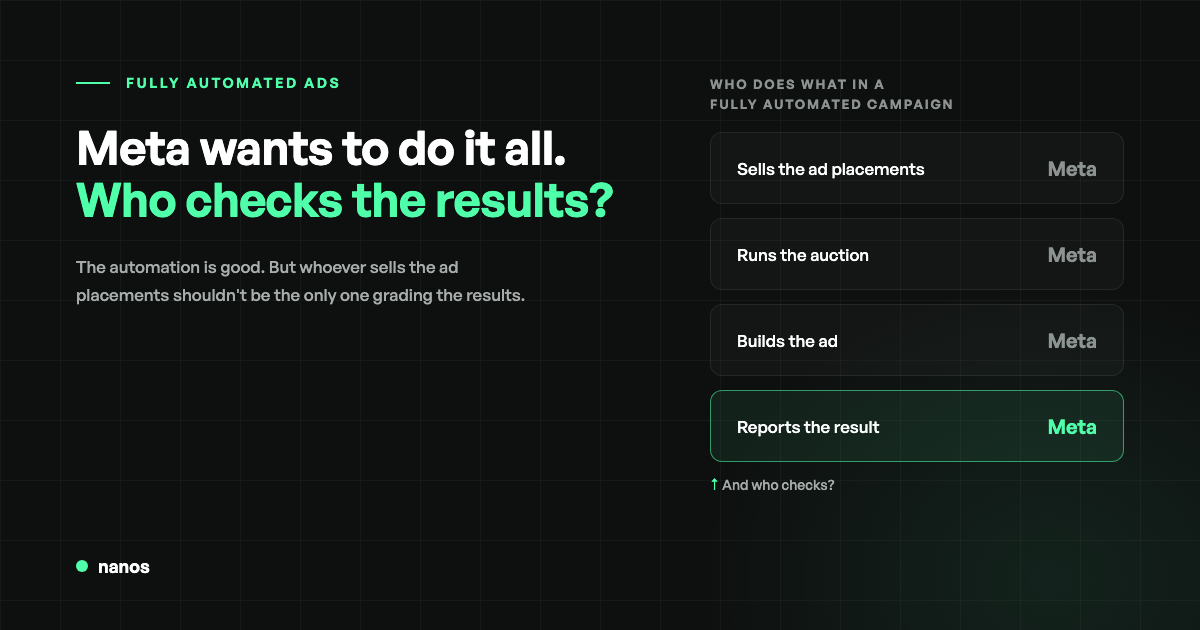
In short: the automation is good, and much of it already exists. But in Zuckerberg’s model, the same company sells the ad placements, sets the price in the auction, creates the ad, decides who sees it — and reports at the end whether it worked. That’s not a reason to avoid Meta. It’s a reason not to let Meta be the only one checking.
What can Meta already automate today?
Most of what’s being discussed as the future is already running. Meta bundles its automation under the name Advantage+: the system picks the audience, the placements and the budget split itself. In the second quarter of 2026, Advantage+ reached an annual revenue run rate of more than $75 billion, according to Meta. Over 9 million small businesses use at least one of Meta’s AI tools for ad creative; use of image generation more than doubled in a single quarter (Meta earnings call Q2 2026).
What’s still missing is the last step: website address in, finished campaign out. According to several reports, Meta is testing this with selected advertisers.
What’s good about the automation?
Let’s start with what’s true: for a bakery, a roofer or a hair salon without a marketing department, this is progress. Not having to understand target groups, placements and bid strategies yourself lowers the barrier. And Meta’s AI is good at its job: in the second quarter, according to Meta, improvements to ad ranking alone brought 8.3% more clicks and 15.7% more conversions on Facebook.
Automation itself isn’t the problem. Nanos is automation too. The question is a different one.
Problem 1: the seller is also the referee
Look at the figures in the last section again and notice who measured them. Every one of them comes from Meta.
That’s normal — there are often no other numbers. But it’s worth knowing what roles Meta holds at the same time in a fully automated campaign: it sells the ad placements, it runs the auction that sets the price, it builds the ad, it decides who sees it — and it reports the result. In the Ads Manager, the column is literally called “Results”.
That doesn’t mean the numbers are wrong. But they have been wrong before:
- In 2016, Facebook admitted that for two years it had overstated the average viewing time of video ads by 60 to 80%, because views under three seconds weren’t counted (Bloomberg).
- Since 2018, advertisers in the US have been suing over the “potential reach” figure. They allege it counted accounts rather than people and was inflated as a result — by up to 400% (Reuters via Yahoo Finance). Meta disputes this; the case is still pending (Meta 10-Q, Q1 2026).
Neither proves bad intent. Both show that a platform grading its own homework makes mistakes — and that it usually takes someone from outside to notice.
Problem 2: Meta only optimises within Meta
Meta’s AI can move your budget between Facebook, Instagram and its other apps. What it will never tell you: “This week, Google search would have got you more for the same money.”
For many local businesses, that’s the more important question. Someone who searches for “roofer near me” on Google already has a need. Someone scrolling on Instagram doesn’t yet. Which of the two is cheaper for you varies from week to week — and only a system that bids on both sides can see it.
Problem 3: the ad is written in your name
When Meta generates images, video and text from your website, an ad is created in your name. The AI is often good at this. But it doesn’t know that the price on the website is out of date, that you don’t offer a particular service any more, or that a certain claim isn’t allowed in your industry.
And there’s something else we’ve noticed in our own campaigns, and it genuinely surprised us: plain AI-generated visuals perform worse than ad creative made by people. More ads in less time doesn’t automatically mean better ads. Our guess: in a feed where soon everyone produces the same kind of image with the same tools, what stands out is what someone recognisably made.
So the oldest rule still applies: read the ad before it runs. A system that lets you “walk away” after entering your budget makes that step easy to skip.
What does Nanos do differently?
Since we’re writing about checking results, let’s be precise about ourselves.
Nanos is automation as well. You say what you want to advertise, in which region and with what budget; Nanos builds the campaign. The ad copy is suggested from the content of your website — and you see it before launch.
Nanos uses Meta’s automation — selectively, not across the board. Our system switches on individual Meta features when they help a campaign. Never everything on, never everything off: we test a lot, and by now we know quite precisely which feature helps which client in which campaign — and which doesn’t. So whether a Meta feature pays off isn’t decided by Meta.
And what Meta can’t do, Nanos does itself. Every day, the AI checks which of your ads and which network are doing best for your money, and shifts the budget there — across Google, Facebook, Instagram and LinkedIn. In a traffic campaign, the most common kind, it optimises for clicks. If you can measure on your website what happens after the click, you can also launch conversion campaigns that optimise for enquiries or purchases.
Our reports also come from the networks. We don’t have a measuring instrument of our own, and we’re not going to claim otherwise. What we do differently: we put the networks side by side. Google’s numbers are measured against Meta’s, rather than each platform marking its own work.
And we don’t sell ad placements. We buy them on your behalf. We don’t earn anything from a click getting more expensive — and you’ll only book with us a second time if it paid off for you the first time.
Do publishers and agencies still have a role?
If you’re a publisher or agency selling online advertising under your own brand as a white-label partner, you’ll hear this from clients in the coming months: “Meta will soon do that itself.” The honest answer has two parts.
Yes, pressing buttons is becoming worth less. Anyone whose service consisted of setting up campaigns in the Ads Manager is competing with a free automation from now on. The agency shares fell for a reason.
But the more the platform decides for itself, the more valuable someone becomes who isn’t the platform. Your client doesn’t need someone to set targeting any more. They need someone who looks at the ad before it runs, who compares more than one network, who knows the local market, and who sits on their side of the table when the results come in. That’s not a weaker argument than before. It’s a clearer one.
What should you keep in your own hands?
Try the automation — but keep a comparison. Whether Advantage+, Google’s equivalent or Nanos: run at least one second network alongside, so the results have something to be measured against.
Define the result yourself. What Meta counts as a “result” is set in the campaign. What counts for you are enquiries, calls, visits to your shop. Write down beforehand what a good month looks like — in your numbers, not the platform’s.
Measure on your own website. A simple analytics tool and a counted contact form tell you more than any dashboard. That’s the second source every platform figure deserves. More on this in our article on ad attribution.
Read every ad before it runs. Especially if an AI wrote it.
Don’t give up on your own visuals. A real photo from your business isn’t on its way out. In our campaigns, creative made by people performs better than plain AI-generated visuals.
Zuckerberg’s vision is honest in its way: tell us your goal, connect your bank account, read the results. Technically, much of it is already working.
The question it leaves open is not whether the machine is good. It’s who checks the machine. As long as the answer is “the company that also sells the ad placements”, it’s worth having a second opinion — and someone at the table who is on your side.
Frequently Asked Questions
- Fully automated advertising. The business supplies a goal, a budget and a website or product image; Meta's AI creates the ad — images, video and text — chooses who sees it, distributes the budget and reports the results. According to the Wall Street Journal, Meta wants to offer this by the end of 2026. Large parts are already available today under the name Advantage+.
- No. For a small business without a marketing department, automation is real progress — Nanos is automation too. The question isn't whether software steers your campaign. It's whose side that software is on, and who checks whether it worked.
- You can use them — you have to, they're often the only ones there are. But Meta is seller, auction house and referee in one. In 2016 the company admitted that it had overstated the average viewing time of video ads by 60 to 80% for two years. And since 2018, advertisers in the US have been suing over the “potential reach” figure, which they allege was inflated. Meta disputes this; the case is still pending. Neither is proof of bad intent. Both are reasons to check results against a second source.
- Yes, selectively. Our system switches on individual Meta features when they help a campaign — but never everything on or everything off across the board. We test a lot, and in doing so we see which feature helps which client in which campaign, and which doesn't. Nanos distributes the budget between the networks itself: every day, across Google, Facebook, Instagram and LinkedIn.
- From the networks themselves — Nanos doesn't run its own measurement. What we do differently is put the networks side by side: Google's numbers are measured against Meta's, not just each one against itself. If you also want to know what happens after the click, measure it on your own website — enquiries, calls, purchases.
- Those who only press buttons for their clients, perhaps. Those who sit on their client's side won't — because the more the platform decides for itself, the more valuable someone becomes who isn't the platform. That's exactly the argument for white label.