68% of Google searches now end without a click — and why that number says nothing about your campaign
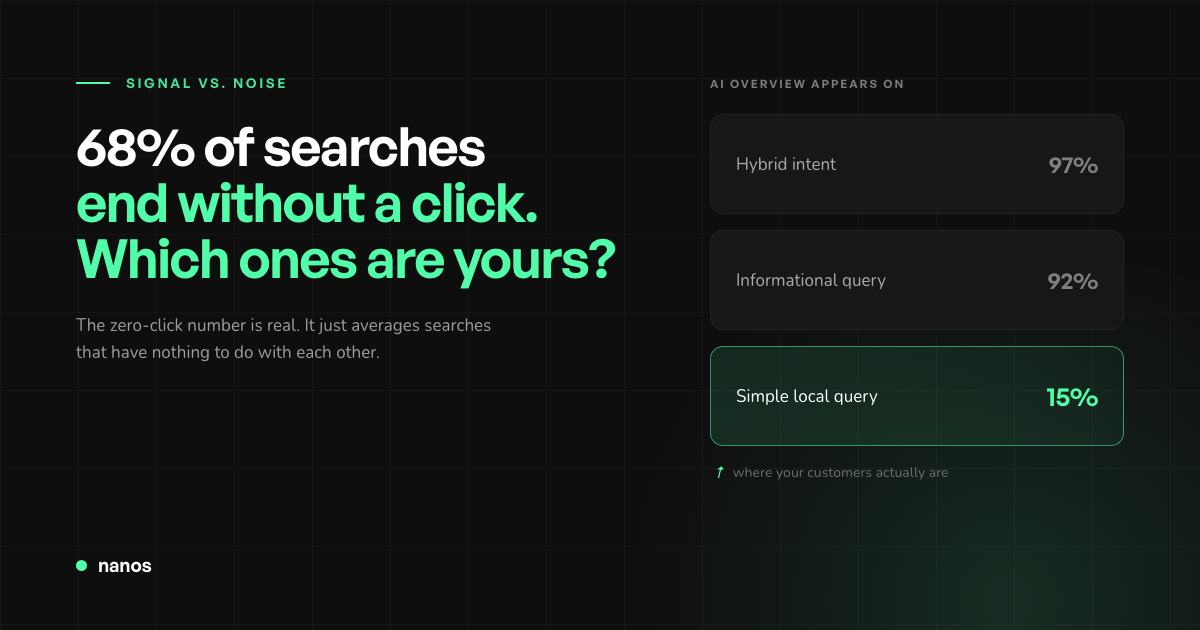
Every few weeks a statistic goes round that sounds like the end of search advertising. The current one is genuinely striking: in the first four months of 2026, 68% of Google searches ended without a single click — up from 60% in 2024, the fastest acceleration in a decade. That comes from SparkToro’s analysis of Similarweb clickstream data for the US, and it is not a soft number.
If you pay for search ads, that reads like a countdown.
It isn’t — and not because the figure is wrong. It’s accurate. It’s because of what it measures, and what it averages together.
In short: the zero-click statistic counts organic clicks, blended across every kind of search there is. Your campaign doesn’t run on the average search. It runs on a particular set of queries, in a particular place, for a particular business. In the same months those free clicks collapsed, paid search grew. Whether AI Overviews are a problem for you is a question only your own numbers can answer.
What the number actually counts
Zero-click means Google answered the question on its own page and the searcher never left. The AI Overview at the top does exactly that, very well, and the click that used to go to somebody’s website simply doesn’t happen.
But an ad is not an organic result. It’s a different surface, sold in a different auction, in a different position on the page. A statistic about Google giving away fewer free clicks is not automatically a statistic about paid clicks.
Two figures from the same window make that concrete:
- In SparkToro’s own data, total clicks fell 22.9% — while paid clicks grew. (They flag that ad blockers in the panel probably understate paid clicks, so if anything that gap is conservative.)
- Alphabet’s Q2 2026 results, reported on 22 July 2026, put Google search and other advertising revenue at $63.3 billion, up 17% year over year — the twelfth consecutive quarter of double-digit growth.
If search advertising were being hollowed out, that second line is where you would see it first. Advertisers in aggregate are spending more, not less. That doesn’t mean nothing has changed — we’ll get to what genuinely has — but the “search advertising is dying” reading isn’t supported by the numbers usually cited for it.
The average hides the only thing that matters
Here’s the part that gets lost every time this statistic travels.
A Whitespark study found AI Overviews appearing on 68% of local searches. Alarming on its own.
The same study, split by what people actually typed:
| What the searcher typed | AI Overview appears |
|---|---|
| Simple local query — “roofer Hanau”, “bakery near me” | 15% |
| Informational query — “how long does a roof last” | 92% |
| Hybrid intent | 97% |
Same dataset. One number gives you a panic headline; the other gives you a plan.
The pattern holds elsewhere. Semrush, looking at more than 600,000 keywords between November 2025 and April 2026, found AI Overviews on transactional searches actually declining by 5% over the period.
There’s a plain reason for it. The closer a search sits to a purchase, the less an AI Overview has to offer. Overviews are good at answering questions. “Which roofer should I call” isn’t really a question — somebody has to be chosen, and the choosing happens in the local pack and in the ads.
So the exposed traffic is the informational traffic: your guides, your explainer pages, your blog. That is a real problem and it deserves attention. It is simply not the same problem as your ads, and treating them as one problem is how people end up cutting the budget that was still working.
What is actually changing
This isn’t a nothing-to-see-here post. Three things in the data deserve to be taken seriously:
- Commercial-intent overviews are growing quickly. In the Semrush window, the share of commercial search results carrying an AI Overview grew 71% in five months. The 15% figure above is not a permanent floor.
- Ads and overviews increasingly share the page. Semrush found results pages containing both appearing roughly twice as often as a year earlier. When an overview sits above your ad, your ad is further down the screen — and that costs click-through.
- Clicks are getting more expensive. Fewer clicks in circulation with the same advertisers bidding for them puts steady upward pressure on cost per click.
So: a moving target, moving at different speeds for different queries, in different industries, in different countries.
The free half of the page is shrinking. The paid half isn’t.
Put the two numbers from earlier side by side. Organic clicks: down 22.9%. Google search advertising revenue: up 17%. Those aren’t contradictory findings. They’re the same event described from two sides.
And Google isn’t treating the AI answer as a click-free zone. At Google Marketing Live 2026 it confirmed ads appearing inside AI Overviews and AI Mode — clearly labelled as Sponsored, placed within the generated answer rather than beneath it. The overview isn’t the end of the commercial part of the page. It’s a new surface to sell.
Read plainly, the direction is not subtle: Google is not removing the commercial opportunity from search. It is moving it out of the half it gives away and into the half it sells.
Which has an uncomfortable corollary and an encouraging one, and they’re the same sentence read twice.
The encouraging version: when there are fewer free routes onto the page, a well-performing ad is worth more than it was, not less. It stops being the thing you do in addition to ranking, and becomes the reliable way in.
The uncomfortable version: a mediocre ad costs more than it used to. Fewer clicks in circulation, the same advertisers bidding, ads competing for attention against a generated answer sitting above them — the gap between an ad that earns its click and one that merely runs has widened, and it now shows up on the invoice.
Which is exactly why an average can’t run your campaign
Think about what we just described. A number that moved 71% in five months, and that differs by a factor of six between two kinds of search sitting side by side in the same study.
By the time a figure like that reaches an article, it is a description of the past, averaged over a set of businesses that are not yours.
The question “are AI Overviews hurting me” does have an answer, and it’s a specific one. It’s in your own campaign: your cost per click week over week, which search terms still bring people in, which ones quietly got expensive, which ads still earn their share. It is not in a headline, and it cannot be.
That is the case for daily optimisation, and it’s the least glamorous thing Nanos does. Every day the AI looks at what your campaign actually did — not at what the industry is doing — and moves budget accordingly: across search terms, across ads, across platforms. If AI Overviews start squeezing the results on the searches your business depends on, that appears as rising cost per click on those specific terms, and the budget shifts within days of it starting.
The system never needed to know the phrase “AI Overview” to respond to one. It responds to your traffic. Hype has no relationship to your traffic.
But daily optimisation is only half of it, and it’s the half that looks inward.
The other half is watching real search demand and how a target group actually behaves — which searches are picking up, which ones are cooling off, and, crucially, which sudden movement is a trend worth positioning for and which is a spike not worth touching. That distinction is almost impossible to make from inside one small campaign, because one small campaign doesn’t have enough data to tell the difference. It’s the difference between reacting to your own noise and acting on real demand.
That plays out differently depending on where you sit.
If you run your own advertising, your campaign is a sample size of one. On a small daily budget — we suggest a minimum of €5 per day per network — one or two clicks a day is often the ceiling, which means your own numbers are too thin to distinguish a genuine shift from an ordinary bad week. Daily optimisation acts on your traffic. The wider view of search demand is what decides whether a movement in it is worth acting on at all.
If you’re an agency, the arithmetic on small accounts has never worked manually. An account spending a few hundred a month can’t carry the hours it would take to manage properly, so it gets either neglect or a template. Continuous optimisation across the whole portfolio — under your own brand, without a performance marketer per client — is what makes those accounts viable to hold rather than something you take on reluctantly.
If you sell advertising to local businesses, your sales team is meeting this exact objection right now: “I read that nobody clicks on Google anymore.” They need two things. The argument above, which is defensible because it’s built on the data the objection came from. And a product that makes the answer true after the contract is signed — where the optimisation is handled by the platform rather than being something a salesperson has to promise on behalf of a colleague.
What to do with all this
Don’t cut search budget on the strength of an industry average. Especially not one built mostly from informational searches when your customers arrive on commercial ones.
Separate the two problems. Losing organic traffic on guide and explainer pages is real, and it’s a content and SEO question. Your ads on “hire”, “buy” and “near me” searches carry a different and much smaller exposure. Different problems, different budgets, different fixes.
Judge your own trend over weeks, not days. A single bad week is noise, especially on a small budget where one or two clicks a day is often the ceiling anyway.
If organic visibility really is compressed on searches that convert, the conclusion is more paid presence there, not less. The overview took the free half of the page. The auction is the half you can still buy into. And if you want to know whether that’s paying off, ad attribution is the place to start.
The honest summary is this: the web has become markedly worse at sending free clicks, and it happened faster in 2026 than in any year before it. The part of that which becomes an emergency for your advertising is far smaller, far more specific, and far more measurable than the headline suggests.
But notice where the clicks went. They didn’t disappear — Google kept them, and is steadily converting the ones it still hands out into ones it sells. In a search results page being rebuilt around that, an ad that performs isn’t a hedge against the change. It’s the part of the page you can still count on.
Whether any of this is happening to you is a question about your campaign — not about the industry.
Frequently Asked Questions
- Indirectly. An AI Overview is not an ad and does not replace one — ads and AI Overviews are separate surfaces on the results page. But when an overview appears above your ad, your ad sits lower on the screen, which costs click-through. Studies show ads and AI Overviews now appear together on the same page about twice as often as a year ago, so this matters more than it did — mostly on informational searches rather than on searches with buying intent.
- No, and the same data shows why. That figure counts organic clicks — the free traffic Google sends to websites. In the very same period, paid clicks grew, and Alphabet reported Google search advertising revenue of $63.3 billion for Q2 2026, up 17% year over year. If search advertising were collapsing, that is the number where it would show.
- Possibly — but check which pages lost traffic first. The losses are heavily concentrated in informational content: guides, explainers, "how does X work" articles. Pages that answer a question are exactly what an AI Overview replaces. Pages people land on when they are ready to hire or buy are far less exposed. If your guide pages dropped and your contact page held steady, that is a content problem, not an advertising one.
- Not on the strength of an industry average. Those averages blend query types that have almost nothing to do with each other — in one study AI Overviews appeared on 92% of informational searches but only 15% of simple local searches. Whether your campaign is affected is visible in your own cost per click and your own search terms, not in a headline.
- No. Nanos optimises your campaign daily against what actually happened — which search terms brought clicks, what they cost, which ads earned their share of the budget. If AI Overviews start squeezing results on the searches you depend on, that shows up as rising cost per click on those specific terms and the budget shifts accordingly. The system does not need to know why a term got more expensive in order to react to it.
- Both, and they're connected. Google confirmed at Marketing Live 2026 that ads appear inside AI Overviews and AI Mode, labelled as Sponsored. So the AI answer is becoming advertising inventory rather than replacing it — which is consistent with organic clicks falling 22.9% while Google's search advertising revenue rose 17%. Fewer clicks in circulation does push costs up. It also means the gap between an ad that earns its click and one that merely runs is wider than it used to be, and that gap now shows up on the invoice.
- No. AI Overviews are a Google search results feature. Meta ads appear in feeds, Stories and Reels, where there is no search result to summarise. If anything, a shift in how people find things through search is an argument for not depending on a single channel.